Batwing!
Batwing 101
My lovely friend Marian visited us recently for moral support. She was having a hard time, so I offered to make her a sweater. “You don’t have to make me a pity sweater,” she told me, but once we got talking about what kinds of sweaters she likes, I absolutely did have to make her a pity sweater, because it turns out that what she likes best are batwing sweaters. I’ve never made one!
Naturally, I’ve had batwing on the brain ever since.
A batwing sweater is distinctive for its sleeve shape, with an armhole opening that hits the body at or below the natural waist. Most batwing sweaters are either knit short, with the bottom of the armhole opening at the waist and ribbing or a decorative waistband beneath, or tunic-length, with dramatic and enormous sleeves whose openings are as long as the sweater itself. They’re often tight at the wrist, with a long length of ribbing to pull in the wide sleeve, but not always. You do you.
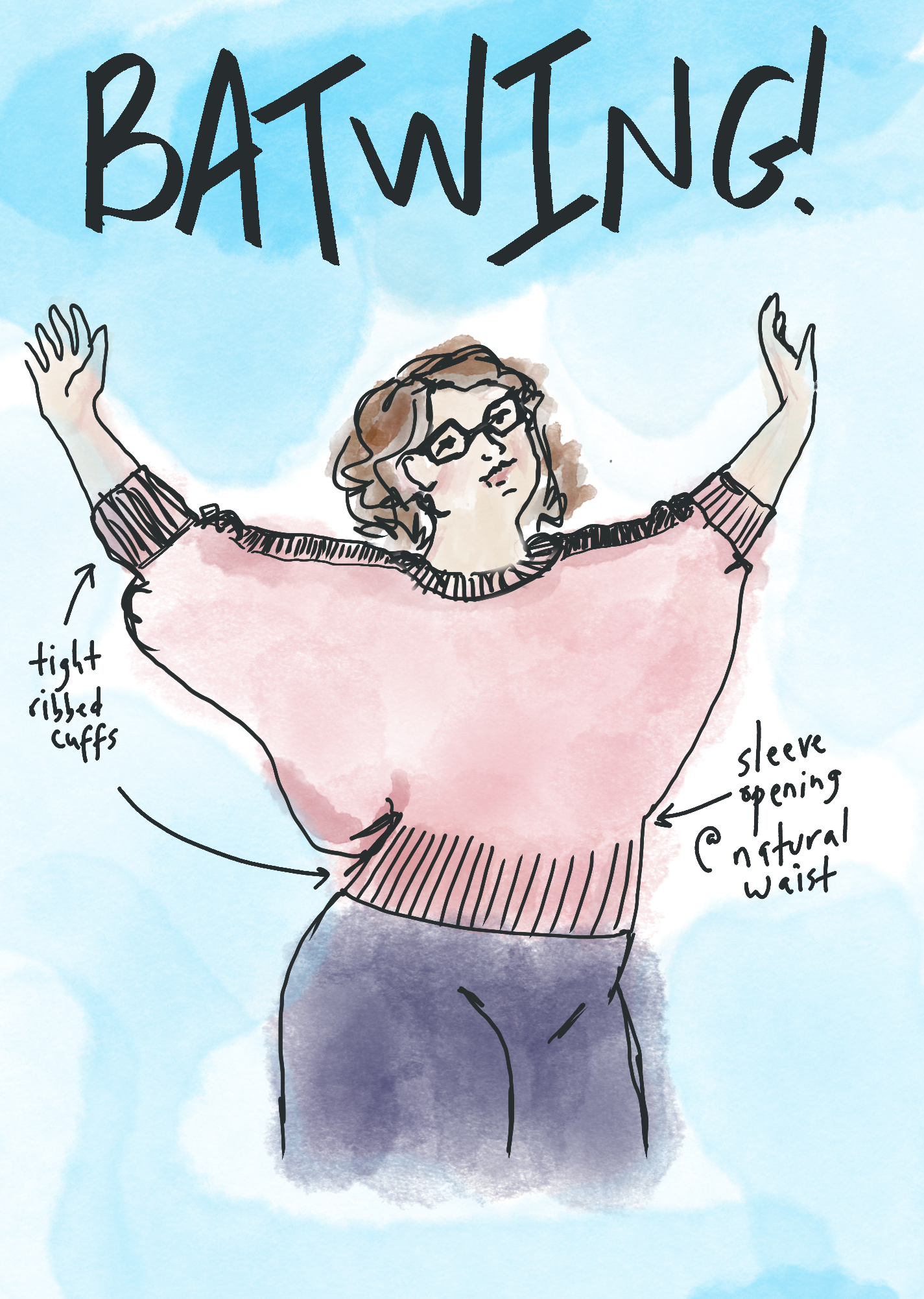
Original illustration © Ruth Homrighaus 2025. All rights reserved.
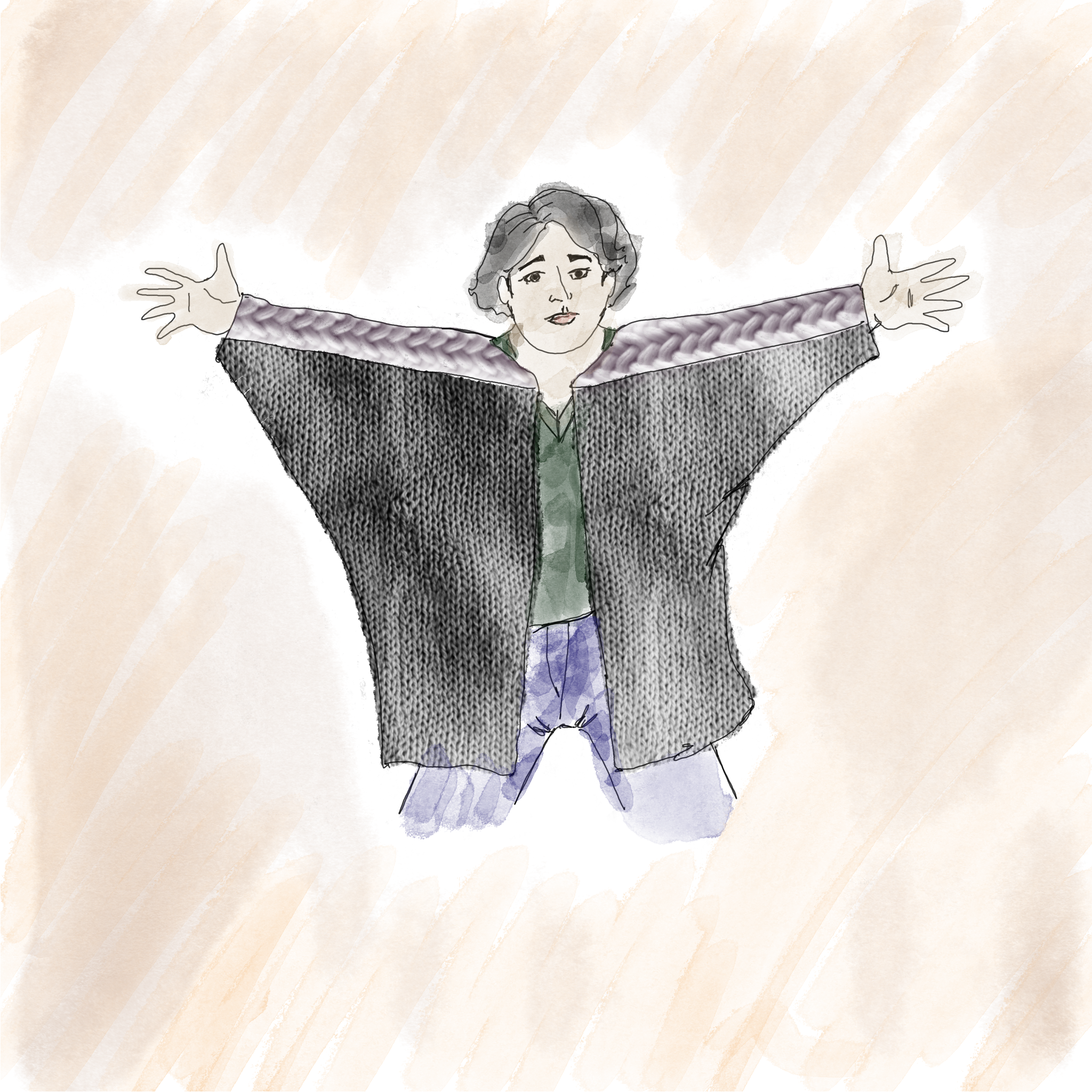
Original illustration © Ruth Homrighaus 2025. All rights reserved.
“Batwing” and “dolman” are sometimes used interchangeably to describe this sweater style, but strictly speaking a dolman sleeve hits the body around mid-rib, making for a considerably less dramatic silhouette. The batwing sweater is for the everyday theatricality of sweeping your arms about, but it’s also for cuddling inside like a small, naked animal, cozy in one’s den for the winter. It’s a silhouette that favors softness and drape, which makes it good for showing off yarn with slink and lustre and showcasing designs that play with horizontal and vertical elements.
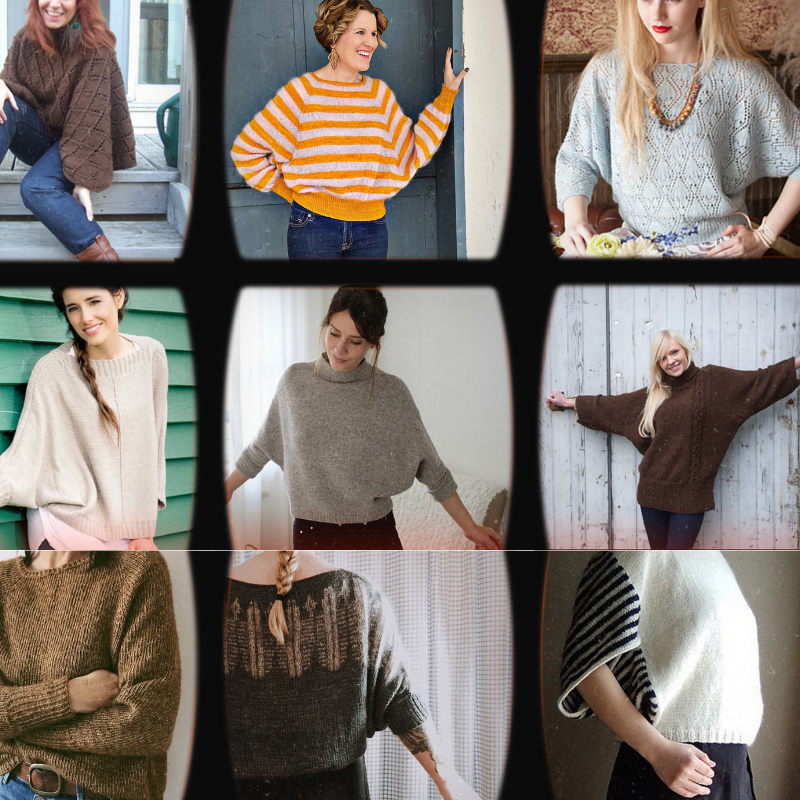
Some vision-board batwing sweaters from Ravelry. Top row, from left: Wallis by Sarah Hatton; Vesper by Devin Ventre; #21 Lace Batwing Top from Vogue Knitting. Middle row: Ana by the Manos del Uruguay design team; Robin Sweater by Susanne Müller; Batwing Jumper by Louise Butt. Bottom row: Raakel Jumper by Rosa P.; Baltian by Caitlin Hunter; Boxy Batwing by Sarah Hatton.
Varieties of Batwing Construction
As a drive-through perusal of Ravelry patterns makes clear, the batwing shape can successfully knit in a lot of different ways. You get to decide how to approach the piecing: you can build a batwing sweater from two pieces (front and back, sleeves and body together) or four (front, back, left sleeve, right sleeve), or the bold batwing can be knit in one piece, as in the Robin sweater above (center row, middle).
You also get to decide on the direction you’d like to work in. The batwing can be cast on at the bottom and knit upward or cast on at the top and knit downward. Or it’s sometimes knit side-to-side, beginning at one wrist and widening until the full sleeve length is reached, then widening out for the body, then narrowing in for the other sleeve.
Even the sleeve construction is up for grabs: your batwing can be a deep sleeve variation on raglan (see Vesper above in the top row), a drop sleeve knit separately, or a sleeve that’s continuous with the body.
The sky’s the limit!
Potential Pitfalls
The delightful bigness of batwing presents inherent issues, however. When knit from the top down, a batwing sweater begins at a width that extends all the way across the body and arms from wrist to wrist. This invites unwelcome gauge surprises, wherein small differences from swatch gauge to actual knitted gauge lead to huge differences in the finished fabric. Even a difference of a quarter stitch every four inches has a huge impact when it’s applied to over three hundred stitches.
Then there is gravity and its nefarious insistence on dragging everything toward the center of the earth. Your gauge swatch won’t have much to say about gravity and how it affects length and width and drape, but your batwing sweater certainly will. A tunic-length batwing sweater made from cotton yarn is going to try much harder to drag on the ground when you walk than a waist-length airy wool confection knit at a loose gauge.
The thing that strikes me as perhaps the most interesting feature of a batwing sweater is how powerfully a batwing sweater asks the knitter to consider, at a granular level, how the individual who will be wearing it wants to look and feel. The reason I’ve never knit a batwing sweater for myself is that I don’t want to wear one. The idea of my arms touching my body on the inside of my clothes makes me shudder. Worse, the notion of lifting my arms and having the entire sweater lift along with them is literally the worst. I can’t wear jumpsuits. If I raise my arm and feel the motion in my crotch, something in my personal mental universe is destroyed, never to be recovered.
My lovely Marian, on the other hand, likes to huddle up inside her big clothes like a baby bunny in a den. She wants the sleeves big, the body loose, and enough length that she can easily pull the sweater over her knees when she’s lounging on the sofa. She asked for a boatneck. She said that if there’s going to be ribbing at the bottom, she’d prefer it nice and loose. This sweater needs to be soft. No wool. Machine-washable. She wants the batwing equivalent of a sweatshirt—but because it is a batwing, and hand-knit, it should also be classy, drapey, and elegant. Perfect garment, right?
Designing Marian’s Perfect Batwing
After mulling it over a while, I decided that I wanted the primary design feature of Marian’s batwing sweater to be a wide band of garter stitch that stretches all the way across the shoulders and both arms to the wrist (interrupted only by the neckline). From this band (actually two bands, because, again, neck), the body is picked up and knit downward in two pieces, back and front. My idea is for the garter stitch over the shoulders to provide just enough ornamentation to show off the sweater’s generous, drapey fall of stockinette. I want a classic sweater whose primary design feature doesn’t distract from the delightful batwing shape.
The garter-stitch bands also provide an immediate and fairly accurate way of measuring the sweater at its widest point. I didn’t want to cast on hundreds of stitches and then have to wait until I’d knit eight or nine inches to figure out if the width was correct. The bands mean I’ll be able to tell pretty quickly if the initial width of the sweater is correct. Knit those narrow three-inch bands, pick up stitches along the edges of one, then cast on for the neckline, pick up stitches along the other band, and measure. Adjust if you overshot or underestimated. The bands have the added bonus of helping to stabilize the sweater over the shoulders and arms so it doesn’t glide louchely around.
With the width sorted, the body is worked first over the back neck and shoulders, widening on every row with short rows until it incorporates the entire sweater width, including both sleeves. Knitting at full width finishes off the making of the sleeves. Then—again with short rows but now in reverse—the sweater is reduced to the desired body width. The waistband and cuffs are six-inch stretches of ribbing, kept loose at the bottom but tighter at the cuffs. Sleeves and sides are seamed up last, or, if additional width is desired, a second set of garter bands can be knit to custom widths and seamed in on both sides.
I made this little experimental video to try to show the process of knitting the sweater.
Spread Your Wings
Marian’s sweater is almost done, and I’m so pleased with it! My intention is to knit a couple other variations of the pattern (which I will keep under my hat for now except to say CATS ARE INVOLVED) and then write up the pattern in a style that will guide anyone through the steps of making their own batwing (or one of my three variations) in any size with any yarn. Look for that next year. In the meantime, thanks for joining me on this journey!